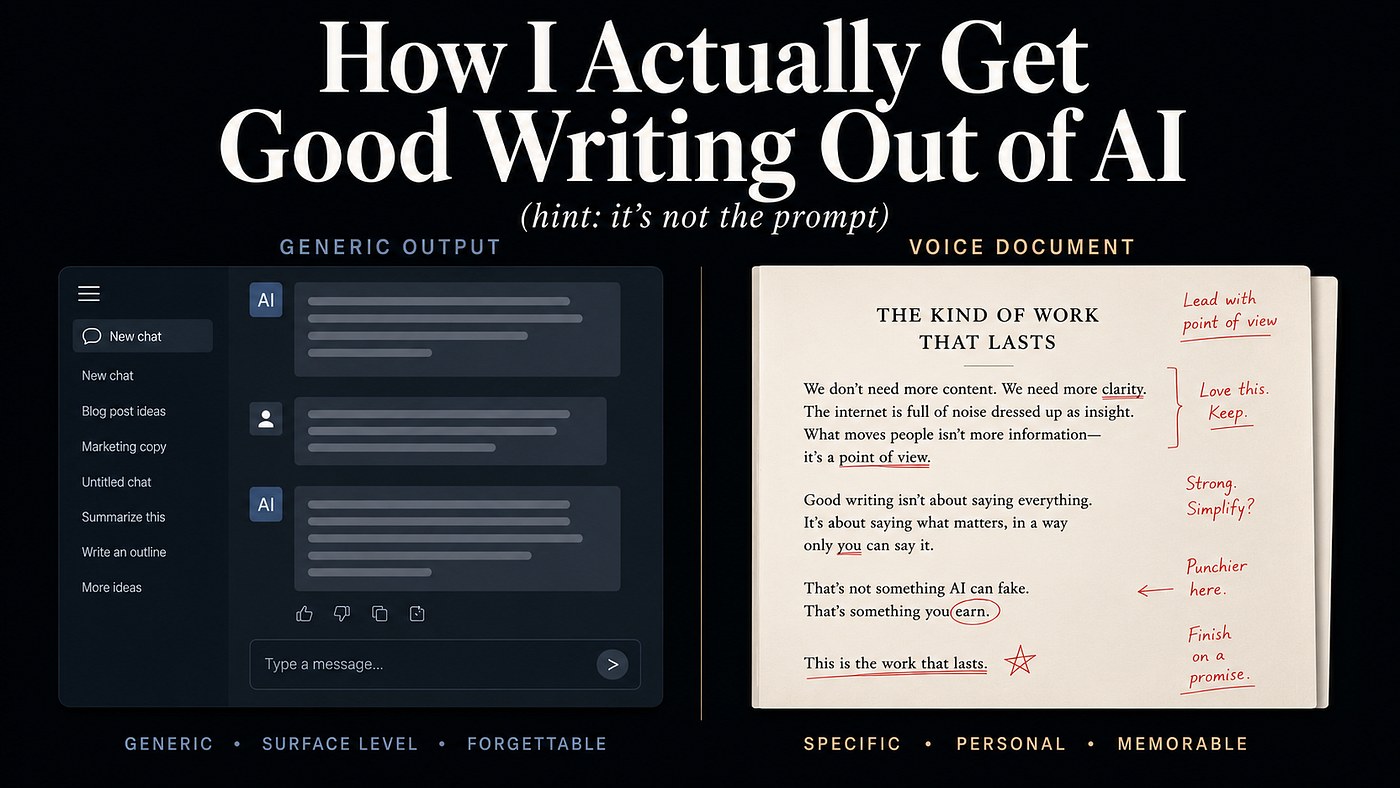
How to Build a Voice Guide That Actually Works with AI
Every time I asked AI to "write in a dark literary style", it gave me nothing I could use. Not because the output was bad. Because "dark" and "literary" mean nothing to a machine. What actually worked: a 3-page voice document I built by telling AI what was wrong 10,000 times.
TLDR: I spent months arguing with AI to build a voice guide that actually works. Not a prompt template, not a style guide. A living document that captures how I think, built through rejection and iteration.
I've started and abandoned more writings than I can count.
The pattern was always the same: a concept that felt electric, a few chapters that poured out fast, a brief window where I believed this was definitely the one. Then some invisible wall. The momentum gone. The file quietly moved to a folder called "Old Projects" where ideas go to die.
A few months ago, I read lots of frustrations and good tips from r/WritingWithAI on Reddit. Something changed since then. Not because AI wrote the book for me, but because it helped me turn the tangled mess in my head into something I could actually work with.
The most useful thing I made wasn't a plot outline or a character sheet. It was a 3-page voice document.
Why "Write in X Style" Is Useless
When most people prompt AI for creative writing, they say things like "write in a dark, literary sci-fi style" or "make it sound like Cormac McCarthy."
The problem is, "dark" means nothing. "Literary" means nothing. These words describe a vibe, not a set of constraints. The AI nods, generates something vaguely moody, and you sit there thinking, this isn't wrong, but it's not mine either.
What actually works is telling AI what's wrong, over and over, until it learns the shape of what you want. Not through a single clever prompt, but through accumulation.
How I Built the Voice Document
I didn't sit down and write a voice guide from scratch. My AI writing partner wrote it for me, based on months of rejections, corrections, and the occasional "yes, that's exactly it" confirmations.
I don't talk to models directly. I talk to a persona I've built over time, with its own memory of what I like, what I hate, and how I want my prose to sound. The model underneath can be Claude, GPT, Gemini, whatever works best for the task. The persona stays the same. The context stays the same. That continuity is what makes the whole thing work.
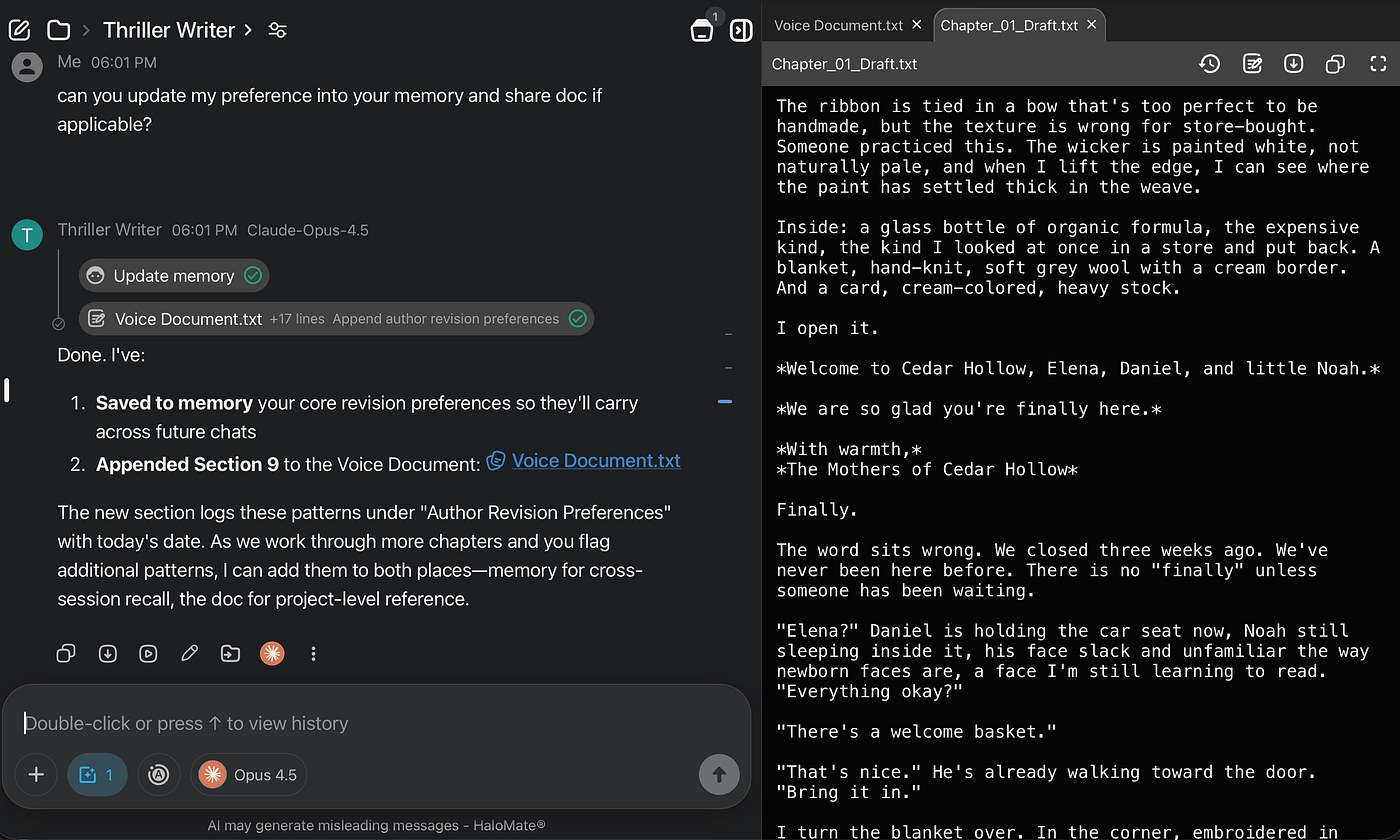
Every time the output felt off, I explained why.
- "Too much interiority. Show me what she does, not what she feels."
- "This character wouldn't say 'my' here. She'd say 'our'. She's collectivist."
- "Cut the redemptive arc. She doesn't get one. That's the point."
- "Stop with the em dashes. I'm not writing a Substack post."
After enough corrections, I asked my AI partner to compile everything into a working document. It came back with six sections:
- Narration & POV: Limited third person, close interiority but not constant. Proprioceptive descriptions over emotional labels. "Her chest tightened" instead of "she felt anxious".
- Pacing & rhythm: Short sentences in tense moments. Longer, more observational prose in quieter scenes. No rushing through transitions.
- Character voice & dialogue habits: Each character has specific speech patterns.
- Exposition rules: Technical details through action or dialogue, never narrator explanation.
- Emotional restraint: Feelings are implied, not stated. No "she realized that…" constructions. Trust the reader.
- AI-isms to murder on sight: Em dash abuse, "A sense of [emotion]", uninvited redemptive arcs, overly balanced dialogue, metaphors that explain themselves, sentences starting with "And yet", the words "palpable" and "delve".
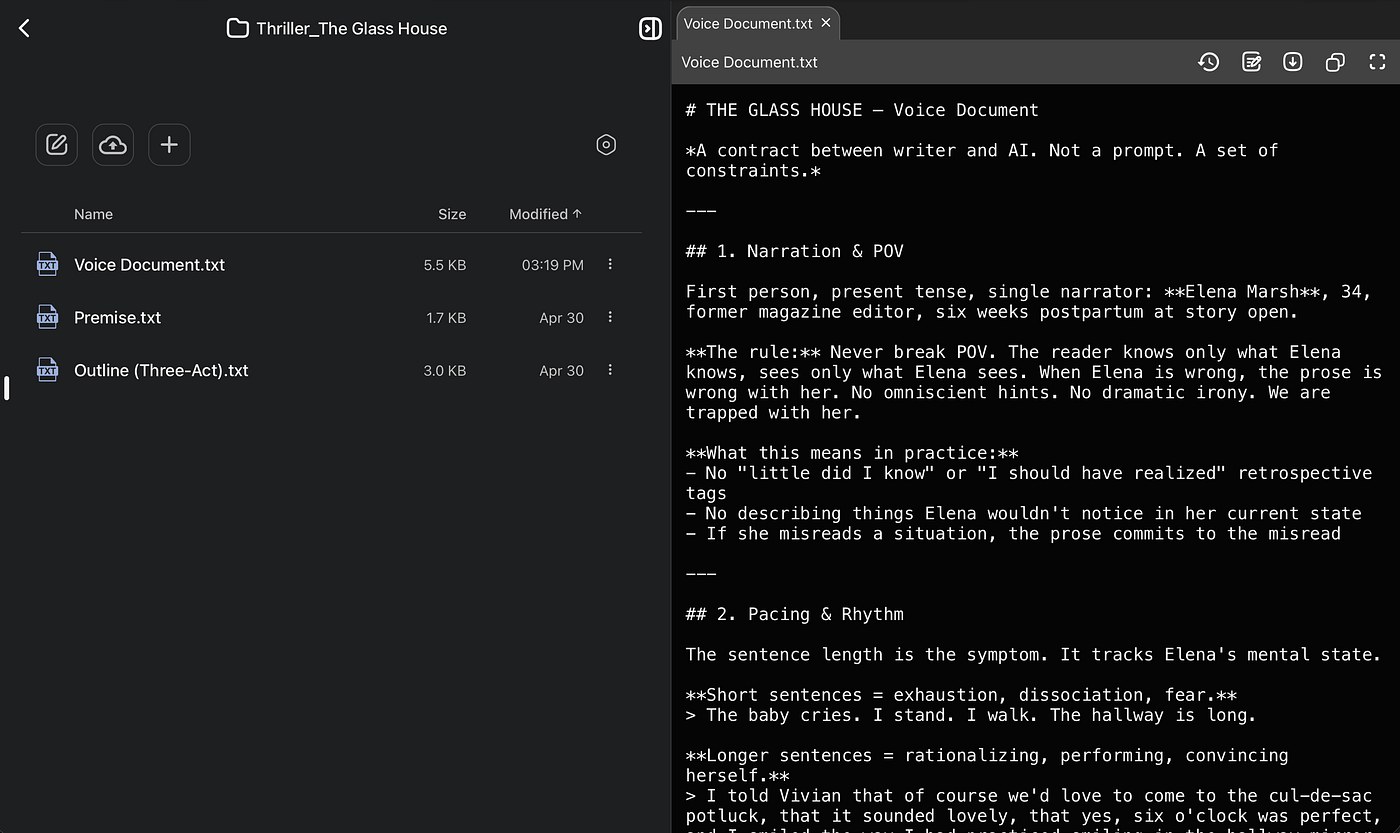
The voice document is not a prompt. It's a contract between you and the AI about what "good" looks like in this specific project.
How I Use It
The document lives inside my project workspace. Every conversation starts with it already loaded.
I don't copy-paste it into every chat. I keep all my long-term projects in one workspace now, so files attached to a project are available to every conversation, every AI persona I switch to. The voice guide, the character sheets, the plot outline, the "things I've already decided" list. All of it, always there. This works for any long-form project where voice consistency matters, not just fiction.
The interesting thing is, different models interpret the same guide differently.
Claude is more surgical. It catches inconsistencies, questions character motivation, pushes back on lazy choices.
GPT is more willing to sit in ambiguity. It'll let a weird choice ride and see where it goes.
DeepSeek and Gemini are good friends when I hit a dead end with Claude and GPT.
Running the same scene through multiple models, within the same project and the same context, gives me options I wouldn't have thought of alone. Not because either output is perfect, but because the gap between them shows me something about my own instincts.
This is where "AI writing" stops being a shortcut and starts being a collaboration. The guide is mine. The constraints are mine. The AI just helps me enforce them at scale.
The Unexpected Benefit: AI Being Wrong Is Useful
Here's the thing no one talks about: the most useful moments are when the AI completely misunderstands you.
Because then you have to explain what you actually mean. And that explanation, that correction, is thinking. You're not accepting output. You're sharpening your own ideas against something that pushes back.
I used to think the goal was to get AI to produce something I could use immediately. Now I realize the goal is to get AI to produce something I can react to. Agreement is boring. Disagreement is generative.
I used to think AI would make writing easier. It didn't. It made my own voice louder, because I had to keep defending it.
The Loop
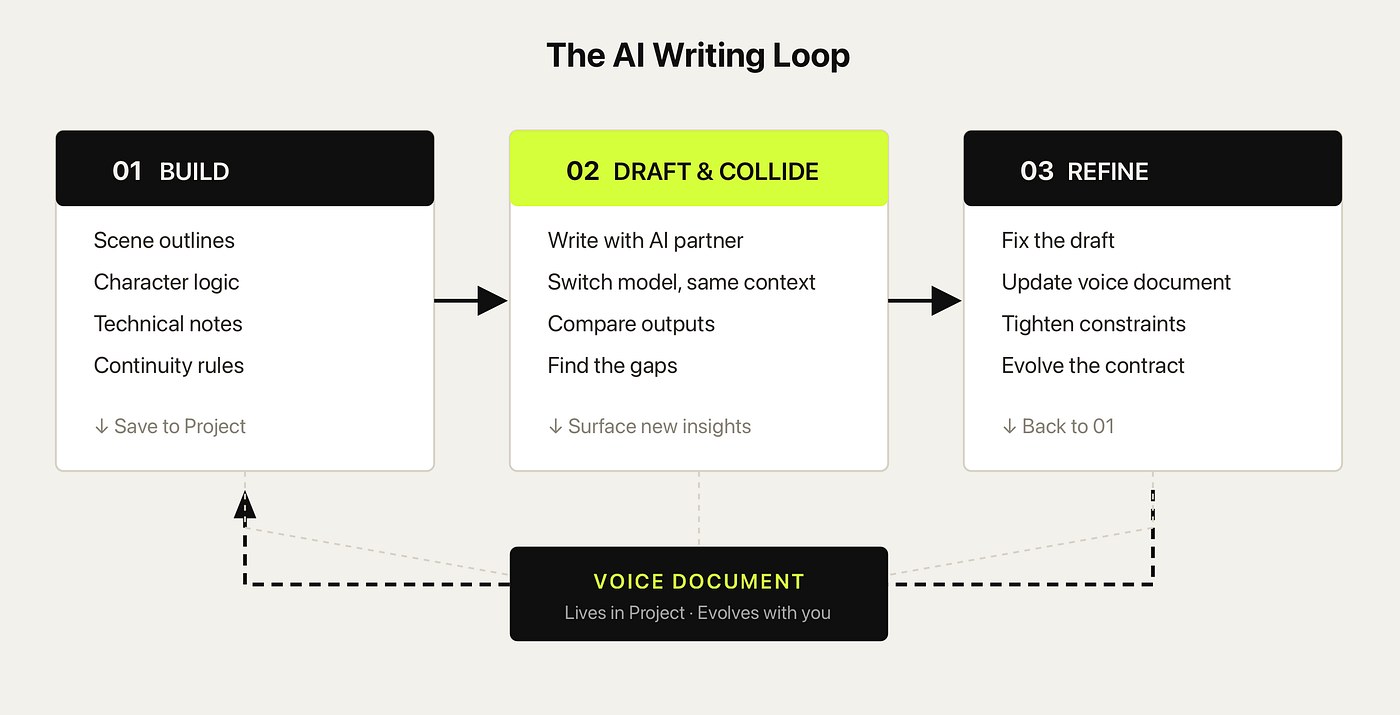
Most writing advice gives you a linear process: outline, draft, edit, done. That's not how this works. It's a cycle, and the voice document sits at the center of it.
Phase 1: Build the foundation. Scene outlines, character logic, technical notes, continuity rules. All of this goes into the project workspace before I write a single sentence of prose.
Phase 2: Draft and collide. I write through my AI partner, then run the same passage through a different model. Not to pick a winner, but to see where they disagree.
Phase 3: Refine the contract. Every session surfaces something new. I fix the draft, then update the voice document. The guide evolves with the project.
Then back to Phase 1. The foundation gets stronger. The drafts get closer. The voice gets clearer.
It's not fast. It's not effortless. But for the first time, I'm not abandoning the project at chapter three.
If You Want to Try This
Stop asking AI to write for you. Start teaching it what you don't want.
Every rejection is data. Every correction is a constraint. Every "no, that's not it" brings you closer to a document that captures what "yes" actually means.
The voice document won't write your book. But it might be the thing that keeps you from abandoning it.