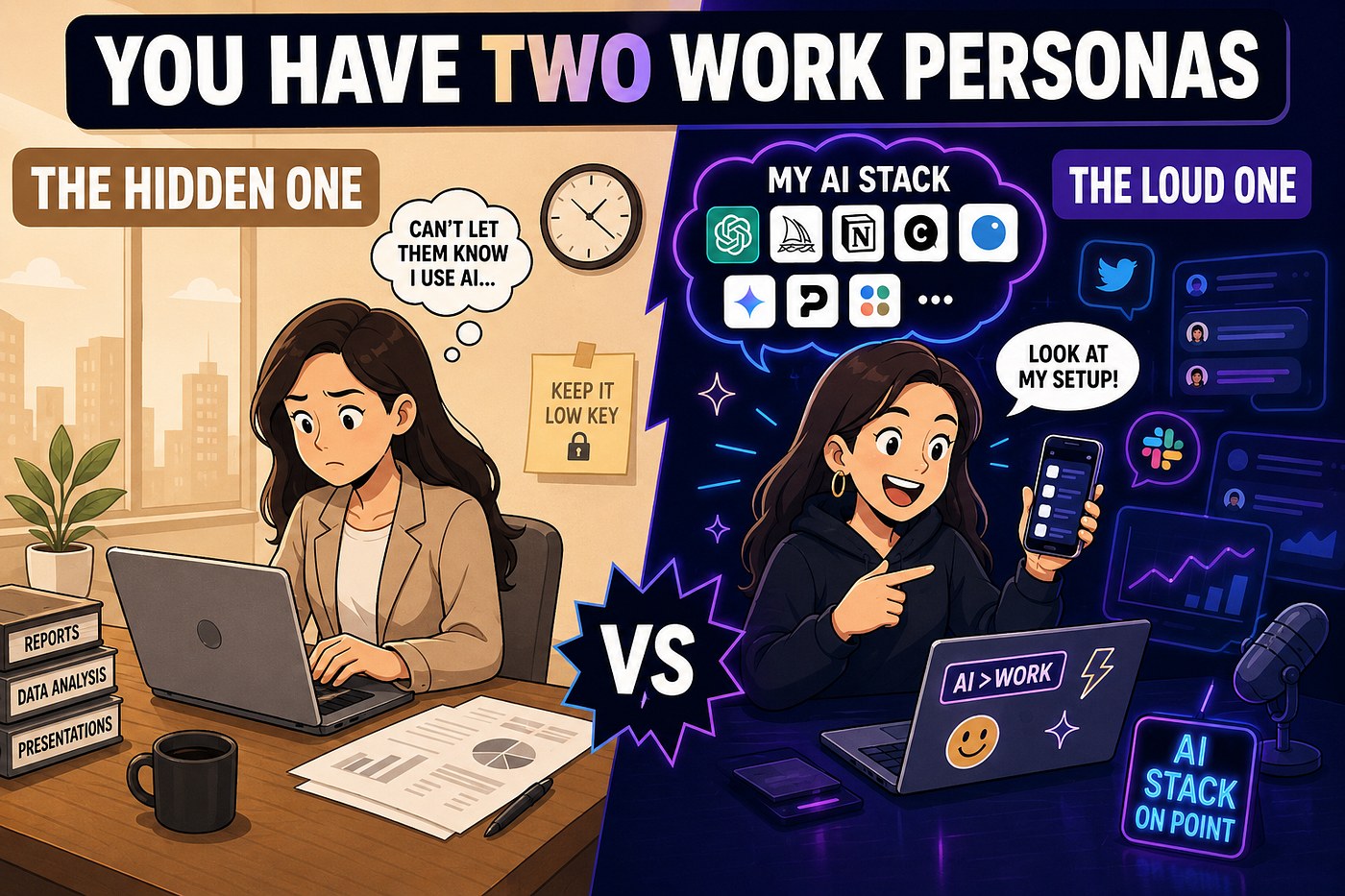
57% of us hide AI use from our managers. The same people brag about their workflow to internet strangers. Here's why we hide, and what stops it.
You have two work personas.
One writes reports, analyzes data, and builds presentations. The other shares "how I work" screenshots on Twitter, discusses workflows in Slack DMs, and curates productivity setups. The first one hides AI use from managers. The second one brags about the AI stack to internet strangers.
This split is everywhere. And it's costing us.
The Data Nobody Talks About
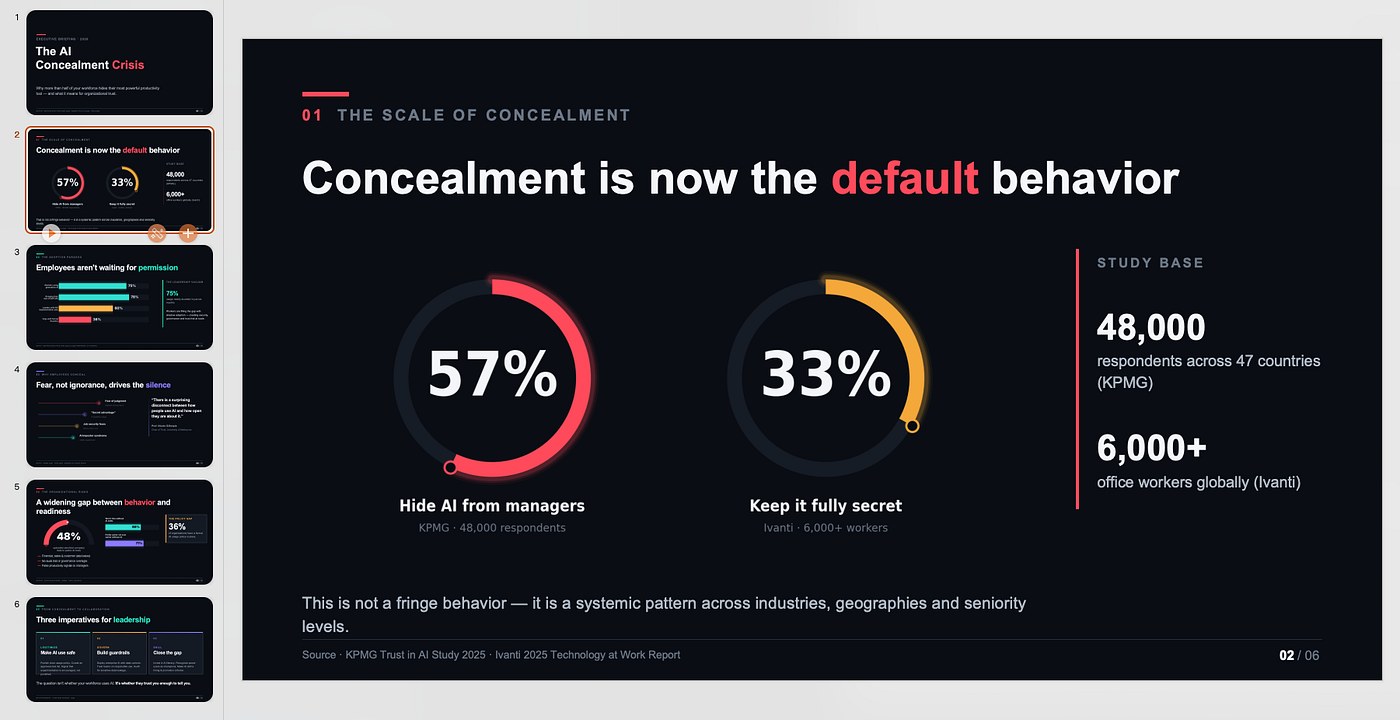
57% of employees actively hide AI use from managers and present AI-generated work as their own (KPMG Trust in AI Study 2025, 48,000 respondents across 47 countries). One in three keeps their generative AI use completely secret (Ivanti 2025).
The higher the stakes, the deeper the hiding. Ethan Mollick has a name for these people: secret cyborgs — workers quietly using AI to outperform, while their org has no idea it's happening.
Here's what's weird about this: the same people hiding AI use from their boss will absolutely post their 47-step AI workflow to Reddit for karma. They'll share screenshots of their AI setup. They'll write Medium posts about their productivity stack.
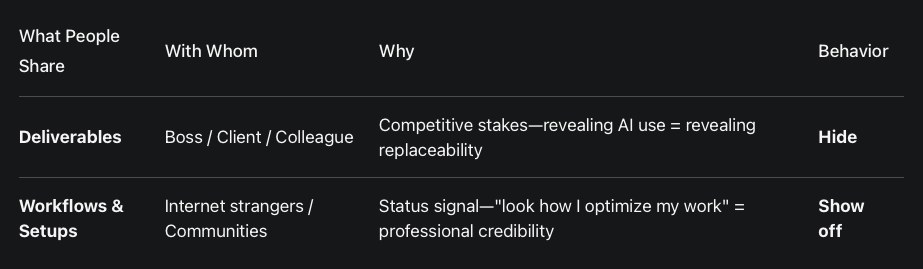
People don't hide because AI is bad. People hide because admitting AI assistance feels like admitting we're optional.
Hiding is selective. It's not about the tool. It's about who gets to see that we're augmented.
How Vibe Coding Changed the Game
Remember when "my code is AI-generated" was an insult?
Then Andrej Karpathy coined "Vibe Coding" in February 2025 and reframed the whole thing. Suddenly, shipping fast with AI went from "you can't code" to "you understand leverage". The tool didn't change. The narrative did.
Developers stopped hiding Copilot. They started competing over who could ship faster with AI-assisted workflows. Same AI, different identity frame.
Vibe Working does the same thing for professional work. Takes the shame out of AI-assisted deliverables and turns workflow transparency into professional credibility.
But you can't just rename what you're already doing and call it Vibe Working. There are actual infrastructure requirements.
What Vibe Working Actually Is
Most people are still using AI like it's 2023. Chat interface. One-off questions. Copy-paste into docs. "Thank you, I'll take it from here."
Vibe Working is different. You stop treating AI like a research assistant you consult occasionally and start treating it like the execution layer of your actual work.
The old model (what most people still do):
- Think through the problem yourself
- Ask AI for suggestions or drafts
- Take the output, rewrite it in your voice, and add context
- Manually assemble everything into a deliverable
- The AI helped. You still did the work.
Vibe Working:
- You define the outcome and set the direction
- AI does the heavy lifting: research, first draft, data crunching, structure
- You steer: "No, try this angle." "Pull from that source." "Reframe this section."
- Not sure? Get a second opinion from another model. Like consulting two experts before you decide.
- AI iterates. You refine. Back and forth until it's right.
- You review the last 20%, make it yours, and ship.
Three things have to be true for this to work:
1. Collaborative execution, not just advice
Old way: "AI, write me a market analysis." You get a draft. You rewrite half of it. You pull data yourself. You format it in PowerPoint.
Vibe Working: You start the analysis in chat. AI pulls research, you say, "focus more on APAC trends". AI restructures. You spot a gap, ask for competitor comparison. AI adds it. You tweak the framing. AI generates the slide deck, charts included. You review, adjust two slides, done.
The deliverable emerges from the conversation. You're shaping it the whole time. AI is doing the execution as you direct.
2. Context persists
Your AI remembers your work. Past projects. Writing style. The files you reference constantly. The frameworks you use. (I went deep on this in the employee handbook I wrote for my AI — persona and memory are the asset, the model is just the engine.)
You don't rebuild context in every new chat. You work in an environment where the AI already knows who you are and what you need.
This is the biggest gap. If you're re-explaining your background in every prompt, you're burning half your time on setup. That's not a workflow. That's playing telephone with a chatbot.
3. Multi-model by default, zero context switching
GPT for brainstorming. Claude for structured analysis. Gemini for research. DeepSeek for bulk data work.
Old way: That means four different subscriptions, four browser tabs, rebuilding context every time you switch.
Vibe Working: Same workspace. Same project files. Same conversation memory. You just swap the model mid-thread when you need a different thinking style. No copy-paste. No "remind me again what we're working on".
The model is infrastructure, not an identity. You don't pick a favorite and defend it in Twitter arguments. You use whichever one fits the task — without losing your place.
What This Looks Like in Practice
Last week I needed a deck on workplace AI adoption trends. Which industries have the highest AI adoption but also the highest concealment rates. The "hidden AI paradox".
Traditional way: half a day hunting McKinsey reports, KPMG studies, Microsoft's Work Trend Index. Extract data into spreadsheets. Build comparison charts. Write insights. Assemble slides. Call it 4–6 hours if you're fast.
What I actually did: opened my workspace, started a new Project, typed my first instruction to my AI assistant.
"Build me an executive deck analyzing workplace AI adoption and concealment behavior by industry. Use public research from McKinsey, KPMG, and Microsoft. Include data, charts, and a slide on implications."
12 minutes later:
- Data pulled from McKinsey State of AI 2025, KPMG Trust in AI Study, Microsoft Work Trend Index
- 8-industry comparison dataset built (adoption rate vs. concealment rate)
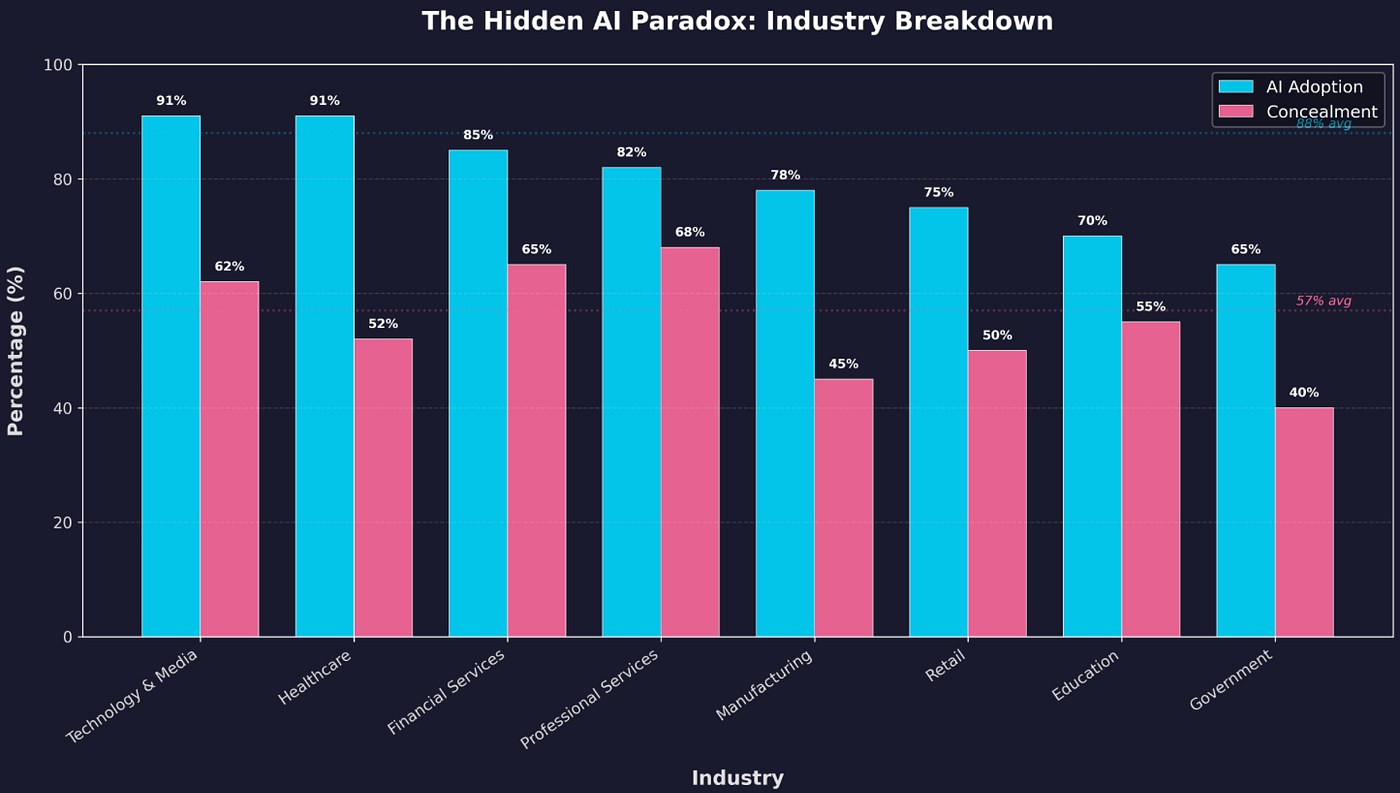
- Dual-bar chart generated with industry breakdown
- 6-slide executive deck created, dark theme, full data viz
- Downloadable .pptx file delivered
The deck was generated on HaloMate using Claude Opus, downloaded as .pptx. I changed two slide titles, reworded one insight to match my voice, added my logo, and sent it.
The AI didn't give me a draft to rebuild. It gave me a 90% ready deliverable that I could tweak in 5 minutes and ship.
That's the shift. From "AI helps me write faster" to "AI executes the workflow, I do final QA".
The deck itself became the data source for this piece. Professional Services: 82% AI adoption, 68% concealment. Highest gap. Tech/Media workers: 91% adoption, still hiding it 62% of the time. Manufacturing and Government: lowest concealment (40–45%). Why? AI positioned as a tool, not a threat.
That last bit — concealment drops when AI is framed as augmentation, not replacement — is the entire reason Vibe Working matters.
I didn't use AI just to brainstorm ideas for a deck. I used AI to execute a research and analysis workflow that used to require a junior analyst. Then I used the output as the foundation for strategy.
Why Organizations Can't Scale AI Right Now
AI adoption is near-universal. 88% of organizations. But most are stuck in pilot purgatory. Only 39% see enterprise-level impact.
The gap isn't capability. It's legitimacy.
Right now companies are "renting" AI productivity. People sneak ChatGPT, hide outputs, hope no one notices. No compounding. No shared learning. No infrastructure.
As long as professionals treat AI as something to hide, you can't:
- Build shared workflows around it
- Train people systematically
- Measure and improve AI-assisted output quality
- Turn individual productivity into institutional advantage
Vibe Working is the narrative shift that makes AI work legible. The identity frame that turns "I'm scared my boss will find out" into "here's how I work now".
When work becomes legitimate: "I used AI" stops being a confession. Becomes a methodology.
When work becomes repeatable: Your AI remembers past projects. Next deliverable starts from where the last one ended.
When work becomes scalable: Workflow saved (personas, memory, files) means you can share it. Teams can clone it. Asset, not secret.
Organizations that get this right won't just have "AI users". They'll have professionals whose AI-assisted output quality is 10x their unassisted baseline. And they'll be proud to say it.
We've seen this movie before. Vibe Coding took developers from "don't tell anyone you used Copilot" to "check out my AI-assisted stack" in 18 months.
Same playbook. Different profession.
If You Want to Stop Hiding
Here's the thing: most companies either ban AI tools outright or give you access to a locked-down enterprise version that logs everything.
Neither option works if you're serious about building with AI.
A confession: I don't put my thinking assets or personal work on the company laptop. I don't use the free LLM account IT set up. Those tools, those outputs, that knowledge base — it all belongs to the company. You can't take it with you.
So I keep a clear line. My setup, my workspace, my accumulated context — that stays mine. The deliverables I create for work? Those go through the company tools. But the how I think, the way I've trained my workflow, the memory and personas I've built up? That's portable. That's mine.
Vibe Working isn't just about working faster. It's about building infrastructure you own. A thinking environment that moves with you, job to job, project to project.
If you're going to invest hundreds of hours teaching AI how you work, you want that investment to compound. Not reset every time you switch companies.
Identity Follows Infrastructure
When enough people have a setup that works — a reliable way to work through AI instead of just with AI — the identity becomes safe to claim.
That's what happened with vibe coding. Developers didn't start calling themselves that until the tools (Cursor, Copilot, Aider) made it normal. The infrastructure came first. The identity followed.
Vibe Working is at that same turning point. The tools exist. The workflows work. What's missing is the permission structure.
And here's what happens when you build that infrastructure early: you start quietly pulling ahead of your peers.
They're still stuck in the "ask AI, copy-paste, reformat" loop. You're iterating in real-time, cross-checking models, shipping faster. They rebuild context every time they switch tools. Your setup remembers. Six months in, the gap is visible. A year in, it's undeniable.
That compounding advantage — that's your moat. Not the fact that you use AI (everyone will eventually), but that you've built a system that gets smarter the more you use it. Personas that know your voice. Projects that hold institutional memory. Workflows that don't reset when you switch jobs.
That's what makes you hard to replace. Not the tools themselves, but the infrastructure you've built on top of the tools.